
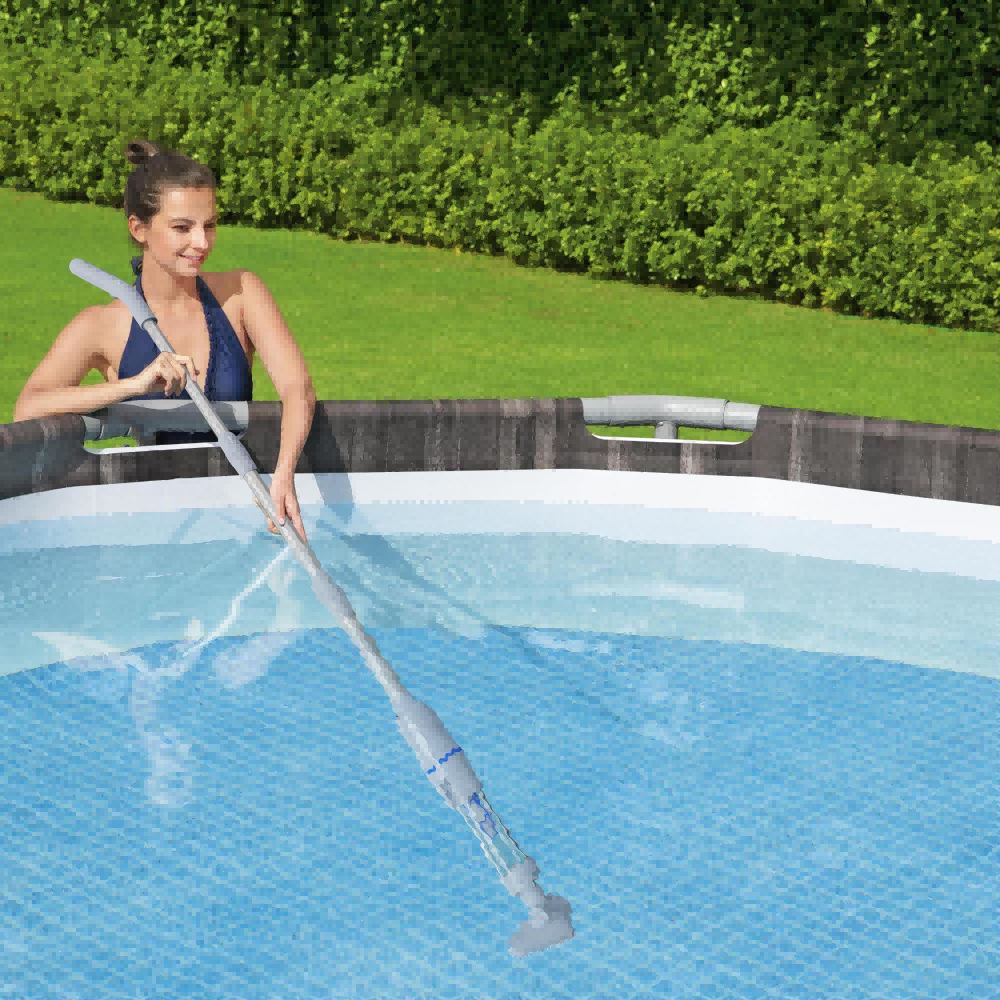
A metal frame swimming pool is a portable pool supported by a metal structure and paired with impermeable liner materials. With advantages like “easy installation, controllable costs, and strong adaptability,” it has become a popular choice for home leisure and commercial scenarios (such as homestays and resorts). Below is a detailed explanation from three aspects: basic introduction, in-depth analysis, and purchasing methods.
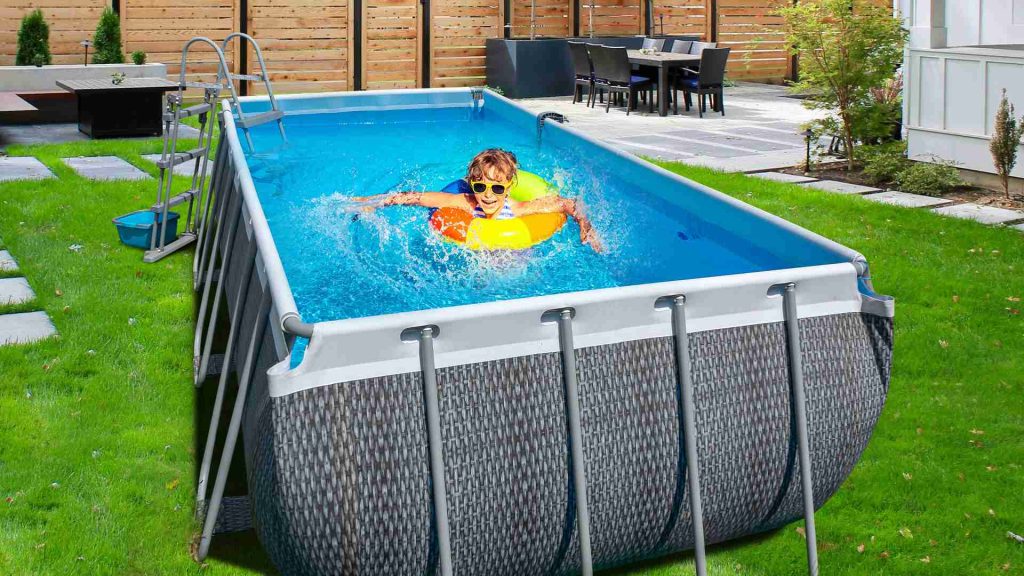
I. Basic Introduction to Metal Frame Swimming Pools
The core of a metal frame swimming pool lies in the combination of “frame support + impermeable liner,” with a design that balances stability and flexibility. Its specific composition and classification are as follows:
- Core Structure
- Metal Frame: As the load-bearing skeleton, common materials are aluminum alloy o galvanized steel.
- Aluminum alloy frame: Lightweight (easy to carry and install), strong rust resistance (suitable for humid environments), but slightly weaker in load-bearing than steel;
- Galvanized steel frame: High hardness, strong load-bearing capacity (suitable for large-sized pools), requiring galvanizing process for rust prevention (to avoid rusting at welding points after long-term exposure to water).
- Liner Material: Usually reinforced PVC (polyvinyl chloride), composed of multiple layers (surface layer for UV resistance, middle mesh layer for tear resistance, inner layer for impermeability). High-quality liners should be ≥0.4mm thick, and multi-layer reinforcement (such as 3 or 5 layers) can enhance durability (puncture resistance, aging resistance).
- Supporting Systems: Some models include filtration systems (water pumps, filter elements for circulating water purification), ladders (for easy access), drains (for quick water change), etc.
- Classification (by Scenario/Form)
- By Usage Scenario:
- Household models: Smaller in size (3-5m in diameter, 0.6-1.2m in depth), suitable for 3-5 people, focusing on portability;
- Commercial models: Larger in size (over 6m in length, over 3m in width, 1.2-1.5m in depth), suitable for homestays, campsites, etc., requiring stronger load-bearing capacity and durability.
- By Shape:
- Circular: Easy to install (uniform frame stress), high water circulation efficiency, suitable for family leisure;
- Rectangular: High space utilization, convenient for activities (such as swimming, parent-child games), suitable for commercial use or scenarios with specific spatial layout needs.
- By Installation Method:
- Above-ground (mainstream): Placed directly on flat ground without civil engineering;
- Semi-buried: Partially embedded in the ground (requiring simple excavation), more stable but less flexible.
II. In-depth Analysis of Metal Frame Swimming Pools
- Core Advantages
- Low Cost and Easy Installation: No need for civil engineering such as concrete pouring. Installation only requires 2-4 people (depending on size) and can be completed in 2-6 hours (saving more than 80% of time and cost compared to traditional pools);
- Strong Portability: It can be disassembled later (frame folded, liner stored), suitable for rental housing or temporary use scenarios;
- Excellent Load-bearing and Capacity: The metal frame provides stable support, and large-sized models (such as 8m×4m) can accommodate more than 10 people, far exceeding inflatable pools (easily deformed and with limited capacity);
- Good Durability: High-quality frames (galvanized steel/aluminum alloy) + multi-layer reinforced liners can last 5-8 years (far longer than inflatable pools which last 1-2 years).
- Potential Disadvantages
- High Requirements for Ground: It needs to be placed on a flat surface (cement ground, lawn, etc. For lawns, a puncture-proof mat must be laid), otherwise it is prone to tilting or liner wear;
- Maintenance Needs: The frame needs regular rust inspection (especially steel, to avoid rust at welding points), and the liner should be kept away from sharp objects (such as stones, pet claws);
- Winter Protection Required: In cold regions (temperature ≤0℃), if not disassembled, the pool water must be drained (to prevent ice expansion from tearing the liner), or choose frost-resistant materials (stable below -10℃);
- Fixed Space Occupation: Although movable, it needs to occupy an area for a long time after installation (more space-consuming for storage compared to inflatable pools).
- Comparison with Other Pools
| Tipo | Piscina con struttura in metallo | Inflatable Pool | Concrete Pool | Wooden Pool |
| Costo | Medium (thousands to tens of thousands) | Low (hundreds to thousands) | High (hundreds of thousands to millions) | Medium-high (tens of thousands to over 100,000) |
| Installation Difficulty | Medium (requires frame assembly) | Simple (just inflate) | Complex (needs civil engineering) | Medium (needs wooden structure construction) |
| Capacity and Load-bearing | Large (for multiple people, stable) | Small (1-3 people, easily deformed) | Large (customizable capacity) | Medium (load-bearing depends on wood quality) |
| Lifespan | 5-8 years | 1-2 years | Over 20 years | 3-5 years (wood easily rots) |
| Flessibilità | Movable (detachable) | High (storable after deflation) | Fixed (non-movable) | Low (structure easily damaged after disassembly) |
III. How to Choose the Right Metal Frame Swimming Pool?
The choice should be based on usage scenarios, environment, and budget and other core needs. The specific steps are as follows:
- Clarify Usage Scenarios and Number of People
- For Home Use: 3-5 people (including children), priority is given to circular pools with a diameter of 3-5m and a depth of 0.6-1m (easy to install and high safety); if adults need simple swimming, choose a rectangular pool of 5m×3m (depth 1.2m).
- For Commercial Use (Homestays/Campsites): For more than 10 people, choose rectangular pools with a length of over 6m, width of over 3m, and depth of 1.2-1.5m. They need stronger load-bearing capacity and durability.
- Evaluate Installation Environment
- Ground Conditions: Ensure it is placed on a flat surface (cement ground, lawn, etc.). For lawns, a PE waterproof cloth must be laid (to prevent grass roots from puncturing the liner); for cement ground, check for cracks (to avoid uneven force on the frame).
- Space Size: In addition to the size of the pool itself, 1-2m of activity space should be reserved around it (for easy access and placing items); in terms of height, consider whether there is a sunshade (to avoid direct sunlight accelerating liner aging).
- Climatic Factors: In cold northern regions (winter ≤0℃), choose detachable models (easy to store) or frost-resistant liners (marked “-15℃ frost-resistant”); in high-temperature southern regions, prioritize liners with UV resistance certification (to delay aging).
- Focus on Core Materials
- Frame Material: In humid areas (such as the south), aluminum alloy is preferred (better rust resistance); for large-sized pools with multiple users, galvanized steel is chosen (stronger load-bearing capacity, and the galvanized layer thickness should be ≥80μm).
- Liner Material: Choose “multi-layer reinforced PVC” (3 layers or more) with a thickness of ≥0.5mm (the thicker, the more tear-resistant). Check for “UV resistance” and “hydrolysis resistance” certifications (to extend outdoor service life).
- Supporting Functions
- Necessary Accessories: Filtration system (select power according to water volume, such as a 5000L pool with a water pump of 1000L/h or more to avoid green water); ladders (especially for depths >1m to prevent falls); drain valves (for quick water change, saving time).
- Budget Allocation
- Household entry-level models (3m×1m): Budget 1000-3000 yuan (including basic filtration);
- Household advanced models (5m×2m): Budget 5000-8000 yuan (aluminum alloy frame + multi-layer liner + efficient filtration);
- Commercial models (8m×4m): Budget 10,000-30,000 yuan (galvanized steel frame + 5-layer liner + large-flow filtration + ladder).
Summary
Metal frame swimming pools are a balanced choice in terms of “cost performance, flexibility, and durability,” suitable for most household and commercial scenarios. When choosing, focus on the three cores: number of users, installation environment, and material quality. Prioritize matching scenario needs (such as small circular pools for families, large rectangular pools for commercial use), and choose high-quality brands (to avoid poor experience caused by frame rust and liner damage in low-cost inferior products).



 Italian
  English
  French
  German
  Spanish
  Polish
  Danish
  Indonesian
  Swedish
  Russian
  Turkish
  Portuguese