
Introduction: The Engineering Behind Pool Maintenance
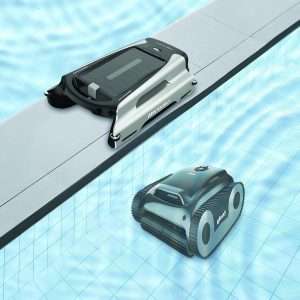
That little robot diligently scrubbing your pool floor isn’t magic – it’s a sophisticated piece of engineering, a quiet convergence of mechanics, electronics, computer science, and fluid dynamics. Understanding how it functions reveals the clever solutions engineers devised to tackle the messy reality of pool maintenance autonomously.

Waterproofing Systems: Surviving Underwater
First and foremost, surviving underwater is non-negotiable. Water and electronics are infamous enemies. To conquer this, robots rely on ingenious waterproofing systems. The cornerstone is often a photoelectric liquid level sensor. Think of it like this: a tiny infrared light source (an LED) constantly beams light towards a receiver. When everything’s dry inside its housing, that light bounces straight back. But if water seeps in – a potential disaster – the light refracts differently through the liquid, scattering away from the receiver. The sudden drop in detected light triggers an immediate alarm or automatic shutdown, protecting the sensitive electronics within. This real-time feedback loop is crucial, acting as the robot’s first line of defense against catastrophic flooding, allowing it to operate safely even at significant depths. Some advanced models add layers of security with pressure sensors, creating a redundant safety net. Without this fundamental protection, the robot simply wouldn’t last.
Intelligent Navigation: Knowing Where to Clean
Once waterproofing is solved, the next big challenge is knowing where to clean and how to get there efficiently. Early robots just bumped around randomly. Modern units are far smarter navigators. They combine various sensors to understand their environment. Electromagnetic sensors help them detect and follow the pool walls by sensing subtle electrical fields. Gyroscopes and accelerometers act like an internal compass and balance system, constantly tracking the robot’s orientation and movement direction. Higher-end models might even use sonar or LiDAR (like underwater radar) to actively map the pool’s contours and obstacles. All this sensor data feeds into an onboard computer running sophisticated path-planning algorithms. The robot essentially builds a mental map of your pool – its size, shape, and any features like steps or ledges. It then calculates the most efficient route, systematically covering the entire surface (walls and floor) in back-and-forth or spiral patterns, ensuring no spot is missed. Some newer robots even “learn” your pool’s layout over time, optimizing their path with each cleaning cycle.
Power and Propulsion: Moving Around Effectively
Moving around effectively requires robust power and propulsion. Most autonomous cleaners run on sealed, rechargeable lithium-ion battery packs (typically 24V or 48V), providing several hours of cordless freedom. Smart power management is key to maximizing runtime; the robot might reduce motor power on gentle slopes, dim non-essential indicator lights during dives, or enter a low-power sleep mode if it gets stuck. Propulsion usually comes from brushless DC motors, prized for their efficiency and reliability. These motors connect to the drive system (like wheels or tracks) through magnetic couplings – a clever design that transfers rotational force without physical shafts penetrating the waterproof seals, preventing leaks. Traction is vital on slippery surfaces. You’ll often find robots using rubber tracks (similar to miniature tank treads) for excellent grip on steep walls and smooth floors, or specially designed omni-directional wheels that allow for tight turns and complex maneuvers. Water jets might also provide vectored thrust for precise positioning.
Cleaning Mechanics: The Core Mission
Of course, the core mission is cleaning. This is achieved through a combination of mechanical and hydraulic action. Rotating scrubber brushes (made from durable, non-scratch materials like nylon or TPR) aggressively loosen algae, dirt, and biofilm from the pool surfaces. Simultaneously, a powerful centrifugal pump creates strong suction, pulling the loosened debris through an intake. The flow rates can be impressive – thousands of gallons per hour – creating an effective vacuum. The dirty water then passes through a multi-stage filtration system, capturing everything from large leaves down to incredibly fine particles as small as 2 microns (like fine silt or pollen). Smart robots don’t just brute force it; they use adaptive cleaning algorithms. Sensors monitor debris load – perhaps detecting increased resistance on the brushes or a pressure drop indicating a clog. Based on this, the robot can automatically increase brush speed and suction power for heavy sediment on the deep end floor, or reduce it to gently clean delicate tile lines or prevent kicking up fine dust.
User Experience and Control: Simplifying Interaction
Interacting with this little helper needs to be simple. While basic models might have just a few physical buttons for start, pause, and maybe a dive function, modern robots offer sophisticated user interfaces. Many connect via Wi-Fi or Bluetooth to dedicated smartphone apps. These apps provide real-time status updates (battery level, cleaning progress, estimated time remaining), allow scheduling, offer remote control, show cleaning history, and even deliver notifications like “Filter Full – Needs Rinsing” or “Obstruction Detected Near Main Drain.” High-end models might even integrate with voice assistants like Alexa or Google Home for hands-free commands. The goal is effortless oversight.
Safety and Maintenance: Ensuring Long-Term Satisfaction
Safety and ease of maintenance are critical for long-term satisfaction. Engineers incorporate features like swivel cables to prevent tangling as the robot moves, and automatic shutdown if motors overheat or encounter an immovable blockage. Maintenance is designed to be user-friendly: quick-release mechanisms allow filters and brushes to be removed in seconds without tools for rinsing or replacement. The entire chassis uses corrosion-resistant plastics and polymers and high-quality silicone seals to withstand constant exposure to chlorinated or salt water. Filters are often easily rinsed with a hose, and modular designs mean worn parts like brushes or tracks can be swapped out effortlessly.
Future Evolution: The Next Generation of Pool Robots
Looking ahead, the evolution is exciting. Future pool robots are poised to become true autonomous pool managers. Machine learning algorithms could analyze historical cleaning data to predict debris accumulation patterns and optimize paths even further. Imagine integrated water quality sensors constantly monitoring pH, chlorine levels, and total dissolved solids, alerting you or even automatically dosing chemicals via a connected system. Solar charging docks could potentially offer near-perpetual operation, while advances in materials science might bring us biodegradable cleaning components and ultra-low-power electronics for greater sustainability. The convergence of smarter AI, robust materials, and user-centric design promises a future where the robot handles not just cleaning, but comprehensive pool wellness, letting you spend less time maintaining your oasis and more time simply enjoying it.
Conclusion: The Journey to Intelligent Aquatic Guardians
The journey from a simple suction cleaner to an intelligent aquatic guardian is well underway, driven by the elegant solutions hidden within that unassuming shell gliding through your pool.




 Turkish
  English
  French
  Italian
  German
  Spanish
  Polish
  Danish
  Indonesian
  Swedish
  Russian
  Portuguese